
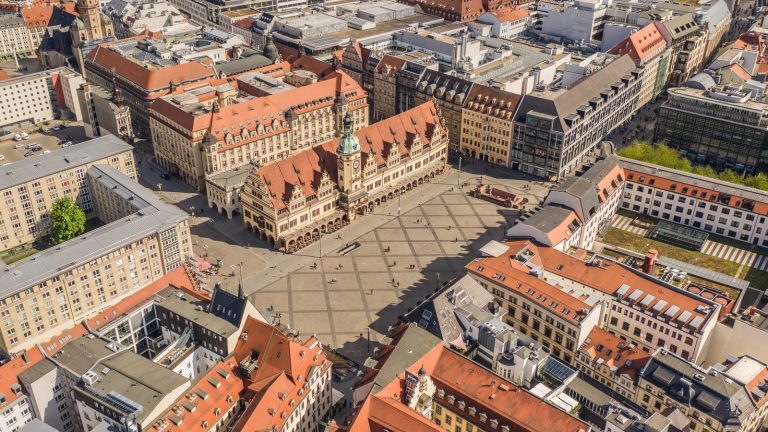
Leipzig has a small but diverse free tour scene, with about five regular itineraries in English and other languages: an introduction to the historic city center, a tour of the city's daily life and history, an alternative tour of the Plagwitz neighborhood, and tours of young Leipzig. There is no upfront payment and no fixed price, and at the end each participant decides for themselves how much to give the guide.
Leipzig is a city best discovered on foot. Its historic core is surrounded by a green ring that marks the line of the old walls, and almost everything of interest within it is within a short walk: the market square and the old town hall, the network of covered passages, the Thomas Church where Johann Sebastian Bach worked, and the Nikolai Church from which the second prayers that led to the Quiet Revolution of 1989 emanated.
That's exactly why the free tour format works particularly well here: a small group, a local guide who knows the streets inside out, and two to three hours to get your head around the city before continuing to explore it on your own. Some of the routes even go out of the center, into the former industrial neighborhoods that have become the most interesting creative areas in East Germany.
Recommended free tours in Leipzig
Leipzig offers five free tours led by local guides through the historic city center, the sites of the Silent Revolution, and the creative Plagwitz neighborhood.
Free Walking Tour - City Center
★ 4.8 · 652 reviews
A first introduction to the historic core of Leipzig: the market square and the old town hall, the covered passages, Bach churches and the sites of the Silent Revolution. A good starting point for a visit to the city.
Free tour daily life and history of the city of Leipzig
★ 4.6 · 42 reviews
A tour that combines the historical story of Leipzig with its everyday side - what life in the city looks like today, what has changed since the days of East Germany, and where the locals themselves hang out.
Alternative Tour - Plagwitz Tour
Leaving the city center to Plagwitz in the west, a former industrial neighborhood that has become a creative center. Renovated factories, graffiti, second-hand shops and the Karl-Heine Canal.
A humorous overview of Leipzig's center
A light and entertaining look at the center of Leipzig, with anecdotes and local stories alongside the main sites. A convenient choice for those who want a first introduction without a heavy lecture.
Leipzig - the new Berlin? Studying, Partying & Living in Leipzig
The student and nightlife side of the city that has been nicknamed the new Berlin: regenerating neighborhoods, a music and entertainment scene, and what it really means to study and live in Leipzig.
The live tour schedule is displayed in English and updated directly from the GuruWalk system - clicking on a tour leads to the booking page.
Why take a walking tour of Leipzig?
A city of music, revolution and walkable streets
Leipzig's distances are walkable, and the historic density in the center is particularly high. On the market square stands the old town hall from the sixteenth century, and behind it opens a network of covered arcades that are a relic of the days when the city was the capital of European trade fairs. In the Mädler Passage sits the Auerbachs Keller, the cellar immortalized by Goethe in "Faust," and a few steps away stands the Thomas Church with the boys' choir that Bach conducted for years.
The story that is not written on the walls
Leipzig's most fascinating chapter is actually the modern one. In the fall of 1989, prayers from St. Nicholas' Church spread to mass demonstrations throughout the Ring, turning the city into the central arena of the Quiet Revolution that led to the fall of the Wall. This story is difficult to understand from just looking at the building; you need someone to stand in the right place and tell you who stepped here, where they went, and what it looked like from the inside. Local guides also point out the less obvious layers - traces of East Germany, new construction that replaced wartime ruins, and an ancient university whose structure was demolished and rebuilt in a way that still stirs debate today.
Beyond the ring road, a completely different Leipzig begins: red-brick factories, canals dug for industrial purposes, and inside them galleries, cafes, and studios. This is exactly the kind of area that is difficult to crack on your own in a short visit, and that a guided tour easily opens up.
Areas and starting points of the tours
The city center and the ring road
Most tours begin in the Augustusplatz area, the large square where the opera house, the Gewandhaus concert hall, and the university tower meet. From there, the walk continues west to the market square, the old town hall, the covered arcades, and the churches of Nikolai and Thomas, and sometimes also to the new town hall with its huge tower and the central train station, one of the largest in Europe.
Plagwitz and the west of the city
Plagwitz is the heart of alternative tours. Built in the 19th century as a planned industrial suburb around the Karl-Heine Canal, the neighborhood was almost completely abandoned after reunification, and came back to life as a creative center. A walk there takes you past renovated factories, graffiti wall after wall, second-hand shops, and small bars along Karl-Heine-Strasse.
The south of the city and the student side
Tours of young Leipzig tend to touch on Karl-Liebknecht-Strasse in Sudfurtstadt, the entertainment street that locals call "Karli" for short, and the surrounding neighborhoods. This is the area that best explains why the city is nicknamed "New Berlin."
Important tips before you go out
Before we go out
Booking a place in advance through GuruWalk is the first step. The groups in Leipzig are relatively small compared to the larger cities in Germany, and not every route leaves every day, so reserving a place ensures that the tour will actually take place and that the guide will know how many people to expect. It is worth arriving at the meeting point a few minutes before the appointed time, identifying the guide by the sign or umbrella, and making sure you are in the group in the right language - the city offers tours in several languages at the same time.
Languages, clothing and weather
Most tours are conducted in English, some in Spanish and some in German, and the language is indicated on the booking page for each tour. A tour in Hebrew is not available in Leipzig, so a reasonable command of English will make a difference. The climate here is continental: pleasant summers but with sudden showers, and cold, gray winters that require a coat, hat and layers. Closed, comfortable shoes are a must in any season, especially on routes that lead out into the industrial neighborhoods with their old, cobblestone sidewalks.
Payment, money and city conduct
The tour itself is given without a fixed price, and the accepted practice is to give the guide an amount at the end that reflects the value you received and the length of the tour. Cash in euros is preferable, and it is advisable to stock up on small bills and coins in advance - there is not always a surplus. In Germany in general, and in Leipzig in particular, there are still places that prefer cash to credit cards, so it is worth keeping some in your wallet. Getting around in the city is convenient: a dense tram network and city train cover every area, and a day pass is worthwhile for those planning to leave the center for Plagwitz or the Memorial to the Battle of the Nations. Note that on Sundays most shops in Germany are closed, so this is an excellent day for a walking tour.
Paid tours and attractions in Leipzig
The tours on the site are free based on a tip; those who want to delve deeper can also combine a guided tour or a paid attraction - these are the leading options in the city:
BELANTIS Amusement Park: Entry Ticket
Entrance ticket to the amusement park in Lantis on the outskirts of Leipzig, with roller coasters, water attractions and themed areas. A full day for children and families outside the city center.
Tickets to Zoo Leipzig
Tickets to the Leipzig Zoo, a major family site in the city with tropical areas, spacious habitats, and a convenient visit route that can easily be combined with a day of sightseeing.
Check availability and price ←Frequently Asked Questions
Are the free tours in Leipzig really free of charge?
There is no fixed price and no payment upon booking. The model is a payment based on satisfaction: you listen to the tour, and at the end each participant decides for themselves how much to give the guide, which is essentially their livelihood. Anyone who is not satisfied with the tour is free to leave at any stage.
Do I need to book in advance?
Highly recommended. Booking is free and done through GuruWalk, and it ensures that the tour actually goes ahead and that the guide knows how many people to expect. During busy seasons and weekends, spots in the small groups fill up quickly.
In what languages are the tours held?
Most tours in Leipzig are in English, and there are also tours in German and Spanish. The language of each tour is indicated on its booking page, so it is worth checking before booking. A tour in Hebrew is not available in the city.
Are the tours suitable for children?
City center tours are suitable for older children who can walk for about two hours and listen to English. With toddlers it is challenging, but the routes in the center are flat and accessible to strollers. The nightlife and entertainment tours are aimed at a more mature audience.
How much is it customary to tip the guide at the end of the tour?
The amount is at your discretion and reflects the quality of the tour, its length and the number of participants. The simple rule is to think about how much you would pay for a similar paid experience, and give according to your ability. Cash in euros is preferable, and it is advisable to stock up on small bills in advance.
When is the best time to go on a city tour?
Late mornings are especially comfortable: the light is good, the center is awake, and the shops are open. In the summer months, late afternoons are also pleasant, and in winter it is better to prefer the early tours because darkness falls early.








